The Chariot (VII): the tarot card
Two sphinxes, one black and one white, and no reins in the driver’s hands: The Chariot runs on will alone. Card VII of the tarot, it stands for movement and composure, a direction rather than a race.
Updated: November 11, 2026
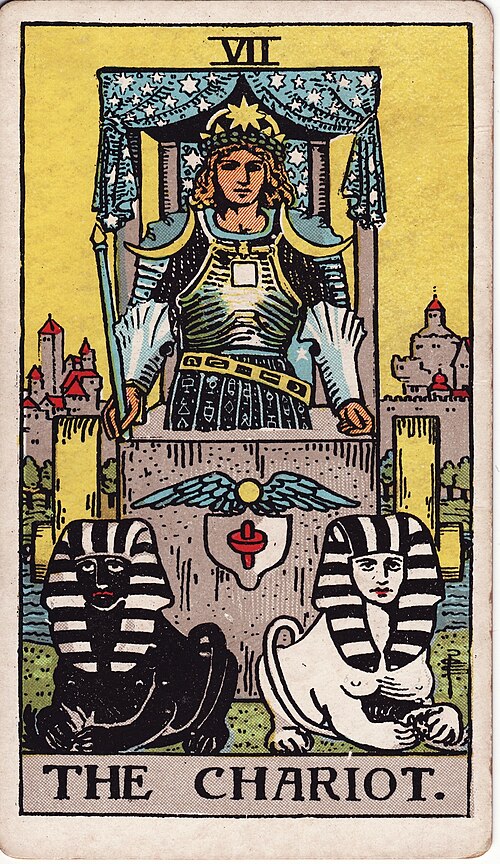
Seventh of twenty-two
The Chariot bears the number VII and follows The Lovers. It is one of the twenty-two Major Arcana in a deck of 78 cards. The first documented decks appeared in northern Italy between 1440 and 1450 and were used for card games; reading meanings into the cards took hold only in the late eighteenth century.
What the card shows
On the 1909 card a crowned driver stands in a chariot under a canopy of stars. Two sphinxes, black and white, draw it, and the driver holds no reins. Older decks harness horses instead. The missing reins are often read as steering by will, the sphinxes as opposites kept moving the same way.
Upright: the course is set
In the tradition, The Chariot upright stands for will, composure and a clear direction. Many readers see in it the skill of holding a course while forces pull different ways: what counts here is not speed but the calm confidence of someone who knows where they are going.
Reversed
Tradition describes The Chariot reversed as lost direction, with each sphinx pulling its own way. Many readers name other readings too: pressure standing in for will, or a chariot standing still although everything is ready for the road.
What the card is not
The Chariot is no race to win and no forecast. It is an image of inner composure. The sphinxes and the starry canopy belong to later decks, the 1909 one among them; older decks harnessed horses.
The Chariot in the row
The Lovers (VI) comes before The Chariot and Strength (VIII) after it: a choice, then movement, then gentle strength. Tradition assigns the card to Cancer. Tarot is a tradition and a language of images, not a science and not a forecast.
The calculation is astronomy; the interpretation is tradition.