The Devil (XV): the tarot card
Ram’s horns, bat wings and a harpy’s feet: The Devil is assembled from borrowed parts, like a masquerade costume. It is the fifteenth card of the tarot, and tradition reads it through attachments, not as a verdict.
Updated: November 11, 2026
Where the look comes from
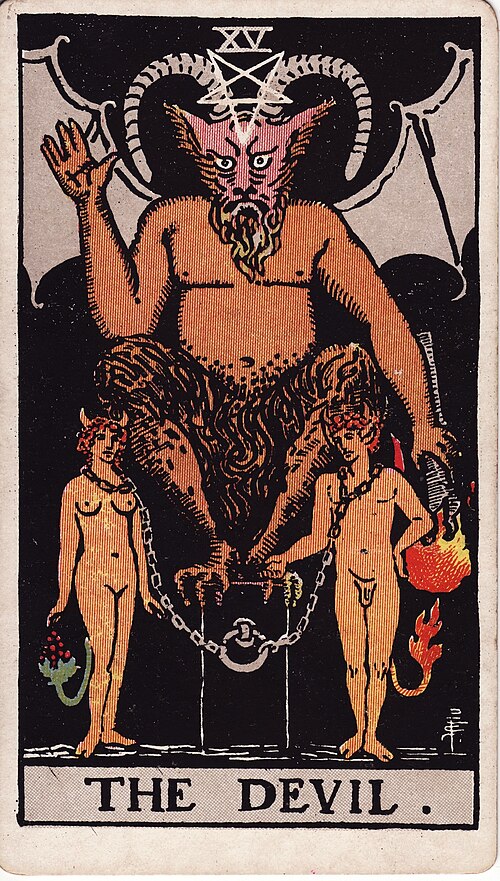
The Devil bears the number XV and follows Temperance. In the Tarot de Marseille, where the card is Le Diable, two creatures with antlers, hooves and tails are tied to a pedestal. The modern image owes part of its look to Eliphas Levi’s “Baphomet” of 1855.
What the card shows
On the 1909 card the figure has a harpy’s feet, ram’s horns, bat wings and a reversed pentagram on its forehead. The right hand is raised; the left is lowered and holds a torch. Two naked figures with tails are chained to the pedestal. The chains are often read as habits a person carries.
Upright: noticing the chains
In the tradition, The Devil upright stands for dependence, attachment and the shadow, the part of oneself nobody likes to mention aloud. Many readers see the card as an invitation rather than an accusation: a chance to look honestly at what holds tighter than one would like.
Reversed
Tradition reads The Devil reversed in more than one way: as release, once a chain is finally noticed, or as denial and shame about one’s own shadow. Many readers point out that everyone has a shadow: it is simply part of being human.
What the card is not
The Devil in tarot is no portrait of a villain and no forecast. It is an image of habits and attachments, whether to things, people or money. Decisions about health, money or law are made with a doctor, a financial adviser or a lawyer; the tradition is a prompt for reflection, not medical, psychological, financial or legal advice.
The Devil in the row
Temperance (XIV) comes before The Devil and The Tower (XVI) after it: after measure come the chains, and after the chains the lightning that breaks them. Tradition assigns the card to Capricorn. Tarot is a tradition and a language of images, not a science and not a forecast.
The calculation is astronomy; the interpretation is tradition.