Temperance (XIV): the tarot card
An angel calmly pours water from one cup to another, one foot in the water and one on the bank. Temperance, card XIV of the tarot, stands for measure and accord: the art of balance.
Updated: November 11, 2026
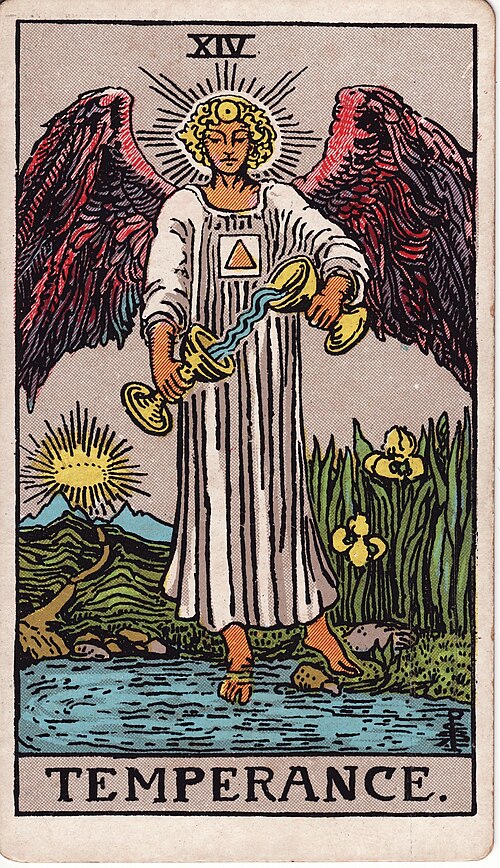
A card of many names
Temperance bears the number XIV in the Tarot de Marseille and most present decks, and follows Death. In the oldest Italian decks it was VI or VII, and its name was La Temperanza. The Thoth deck calls it “Art”, and Iris and the archangel Michael are among the suggested identities of its angel.
What the card shows
On the 1909 card a winged angel pours liquid from one cup into another. One foot is in the water and one on land; a square and a triangle sit on the chest, and irises bloom nearby. In the lower left a path leads off to a crown. The pouring is often read as blending opposites, the path as a road walked calmly, step by step.
Upright: the golden mean
In the tradition, Temperance upright stands for measure, accord and patience. Many readers see in it the knack of joining what seems unjoinable: work and rest, impulse and calm, one’s own and another’s. It is the card of a recipe with exactly the right amount of each ingredient.
Reversed
Tradition describes Temperance reversed as lost measure: too much of one thing, too little of another, and everything wanted at once. Many readers also name a balance that is only for show, calm on the surface while inside the cup ran over long ago.
What the card is not
Temperance is no call to dullness and no forecast. It is an image of a living balance that keeps adjusting. The irises, the square and triangle and the path to the crown are details of the 1909 deck.
Temperance in the row
Death (XIII) comes before Temperance and The Devil (XV) after: a change, then a new measure, then a test of attachments. Tradition assigns the card to Sagittarius. Tarot is a tradition and a language of images, not a science and not a forecast.
The calculation is astronomy; the interpretation is tradition.