The Hermit (IX): the tarot card
A single lantern on a mountain top, with a six-pointed star inside: The Hermit has more light than it seems. Card IX of the tarot, it stands for chosen solitude and an inner search.
Updated: November 11, 2026
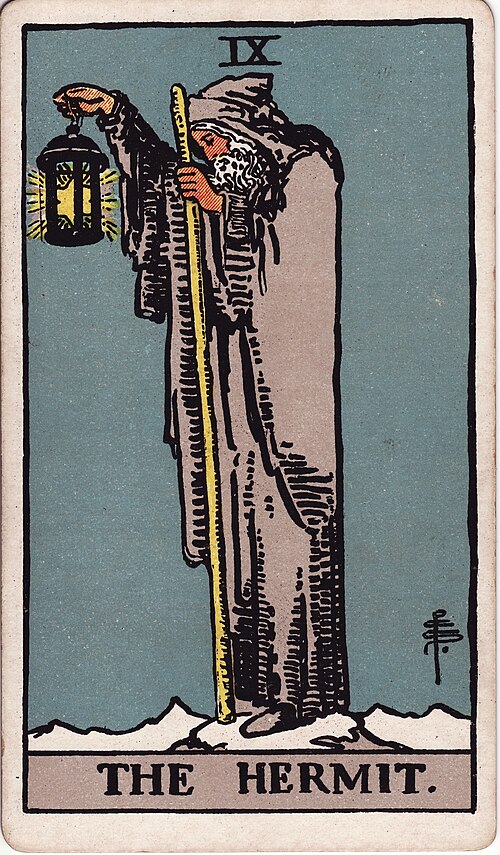
Who drew this deck
The Hermit bears the number IX and follows Strength. William Rider & Son published the 1909 deck, drawn by Pamela Colman Smith on the instructions of A. E. Waite; both belonged to the Golden Dawn. Before it the Minor Arcana mostly had simple designs, and Waite explained his images in The Pictorial Key to the Tarot of 1911.
What the card shows
On the 1909 card an old man in a cloak stands on a mountain peak. One hand holds a staff, the other a lit lantern with a star, and a range of mountains lies beyond. Eden Gray read the lantern as the lamp of truth, the staff as help on narrow paths and the cloak as discretion.
Upright: a light of one’s own
In the tradition, The Hermit upright stands for chosen solitude, an inner search and the experience that comes with the years. Many readers see a pause a person takes on purpose: stepping away from the noise to hear one’s own thoughts. The lantern lights exactly one step ahead, and that is enough.
Reversed
Tradition describes The Hermit reversed as solitude that has turned into isolation, or the opposite, too little quiet, with no time to be alone. Many readers also recall the lantern that was never lit.
What the card is not
The Hermit is no call to leave people behind and no forecast. It is an image of the quiet in which thinking comes easier. The six-pointed star in the lantern is a detail of the 1909 deck.
The Hermit in the row
Strength (VIII) comes before The Hermit and Wheel of Fortune (X) after: gentle strength, then quiet, then a turn. Tradition assigns the card to Virgo. Tarot is a tradition and a language of images, not a science and not a forecast.
The calculation is astronomy; the interpretation is tradition.