Wheel of Fortune (X): the tarot card
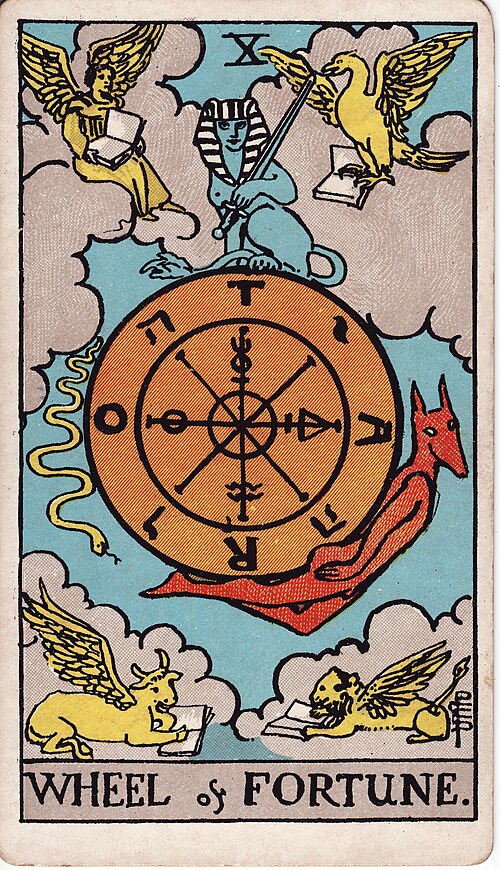
A serpent sliding down on the left, Anubis rising on the right, and the wheel still turning: Wheel of Fortune loves motion. Card X of the tarot, it stands for change and cycles, a turn rather than blind chance.
Updated: November 11, 2026
A wheel from the Middle Ages
Wheel of Fortune bears the number X and follows The Hermit. Since the fifteenth century the card has been modelled on the medieval Rota Fortunae, drawn with six or eight spokes. The idea behind it is old and simple: everything turns, and what is low comes up.
What the card shows
On the 1909 card the letters T-O-R-A alternate on the wheel with Hebrew letters and the alchemical signs of the four elements. Four winged creatures sit in the corners: a lion, an ox, a man and an eagle. Anubis rises on the right; the snake Typhon slides down on the left. The four creatures are linked with the Evangelists and with Taurus, Leo, Scorpio and Aquarius.
Upright: the wheel has turned
In the tradition, Wheel of Fortune upright stands for change, cycles and a turn after which things look different. Many readers note that a wheel has no permanent top or bottom: it invites a look at which circle is closing, and a calm step into the next.
Reversed
Tradition describes the reversed Wheel as resistance to change, or as a closed circle in which the same story repeats again and again. Many readers also read it more gently, as a slow turn that takes its time.
What the card is not
Wheel of Fortune is no lottery and no forecast of luck. It is an image of life’s rhythm, where ups and downs take turns. The letters and signs on the wheel are details of the 1909 deck; other decks draw it differently.
The Wheel in the row
The Hermit (IX) comes before the Wheel and Justice (XI) after: quiet, then a turn, then balance. The four creatures in the corners of the wheel also watch over the last card of the row, The World. Tarot is a tradition and a language of images, not a science and not a forecast.
The calculation is astronomy; the interpretation is tradition.