The Hierophant (V): the tarot card
Two fingers up, two down, and keys at his feet: The Hierophant blesses and teaches at once. Card V of the tarot, he stands for learning and shared rules, and tradition reads him as a mentor, not a warden.
Updated: November 11, 2026
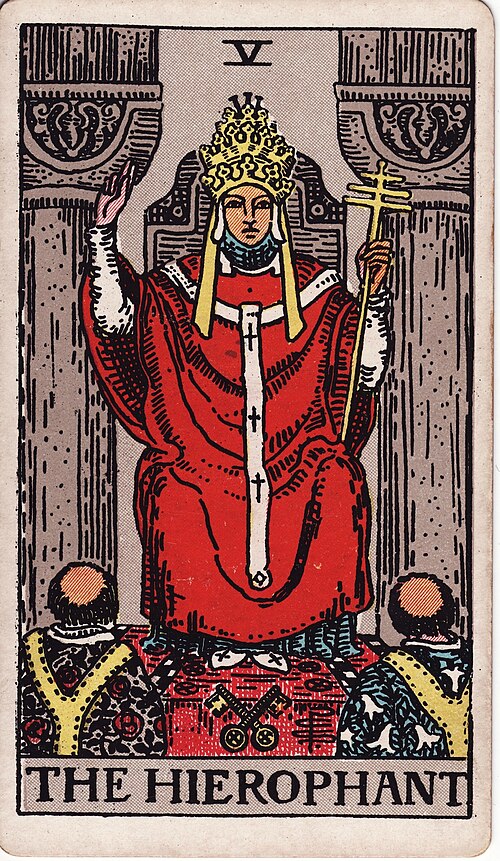
Once the Pope
The Hierophant bears the number V and follows The Emperor. Early decks and the Tarot de Marseille call the card Le Pape, the Pope. The name “Hierophant” comes from Antoine Court de Gébelin, who wished to de-Christianise the French pack. The card is also called the High Priest.
What the card shows
In many modern packs, the 1909 deck among them, The Hierophant sits on a throne between two pillars. His right hand is raised in blessing, two fingers up and two down. His left holds a triple cross; he wears a papal tiara, keys lie at his feet, and worshippers stand before him.
Upright: someone to learn from
In the tradition, The Hierophant upright stands for learning, mentoring and the shared rules a community rests on. Many readers see a teacher, a school or a tradition in him: experience passed from hand to hand instead of being worked out from scratch. It may be a master teaching a craft, or a family with its customs.
Reversed
Tradition describes The Hierophant reversed as a rite the meaning has gone out of, or as a search for one’s own road away from shared rules. Many readers also recall here the mentor who stopped learning himself. The search for one’s own road is read here as growing up rather than rebellion.
What the card is not
The Hierophant is no call to religion and no forecast. He is an image of knowledge passing from person to person. The tiara and the triple cross remain from the card’s older name, the Pope.
The Hierophant in the row
The Emperor (IV) comes before The Hierophant and The Lovers (VI) after him: order, then teaching, then a choice of one’s own. Tradition assigns the card to Taurus. Tarot is a tradition and a language of images, not a science and not a forecast.
The calculation is astronomy; the interpretation is tradition.