The Emperor (IV): the tarot card
A stone throne carved with ram heads, armour under a red robe and mountains behind: The Emperor sits firmly. Card IV of the tarot, he stands for order and responsibility, and tradition reads him as support, not command.
Updated: November 11, 2026
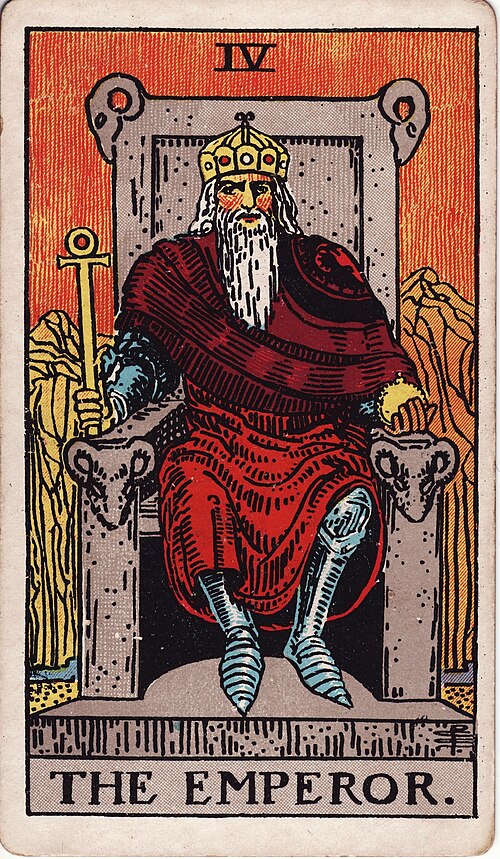
Why rams on the throne
The Emperor bears the number IV and follows The Empress. The card has been in tarot decks since the fifteenth century. Later decks, the 1909 one among them, carve ram heads on his throne, the sign of Aries. The Golden Dawn and its successors added astrological and Kabbalistic correspondences to the cards.
What the card shows
On the 1909 card The Emperor sits on a stone throne with ram heads. He wears armour and red robes, holds a sceptre and an orb, and mountains rise behind him. The stone and the mountains are often read as stability, the armour under the robe as readiness to answer for his own.
Upright: a solid foundation
In the tradition, The Emperor upright stands for order, authority and responsibility. Many readers see in him the skill of building structure: rules, routines and boundaries that hold a home, a business or a team together. Nothing extra, everything in its place. His order is not for its own sake: it is a frame to grow on calmly.
Reversed
Tradition reads The Emperor reversed two ways: as rigidity and control, when order starts to choke, or as missing support, when there are no rules at all. Many readers add weariness with the role of the one who answers for everything.
What the card is not
The Emperor is no tyrant and no forecast. He is an image of stability built by one’s own hands, and authority here means, above all, answering for others. The ram heads on the throne are a detail of later decks, the 1909 deck among them.
The Emperor in the row
The Empress (III) comes before The Emperor and The Hierophant (V) after him: abundance, then order, then teaching. Tradition assigns the card to Aries, the first sign of the zodiac. Tarot is a tradition and a language of images, not a science and not a forecast.
The calculation is astronomy; the interpretation is tradition.