The Magician (I): the tarot card
An infinity sign overhead, a snake for a belt and every suit on the table: The Magician has everything to hand. Card I of the tarot, he stands for will and skill, the bridge from idea to work.
Updated: November 11, 2026
From street juggler to magus
The Magician bears the number I and comes right after The Fool. The Tarot de Marseille calls him Le Bateleur, “the juggler”; in Italian he is Il Bagatto. On the oldest painted version, from the Visconti-Sforza deck, a man appears to play with cups and balls. Occultists later turned the mountebank into a magus.
What the card shows
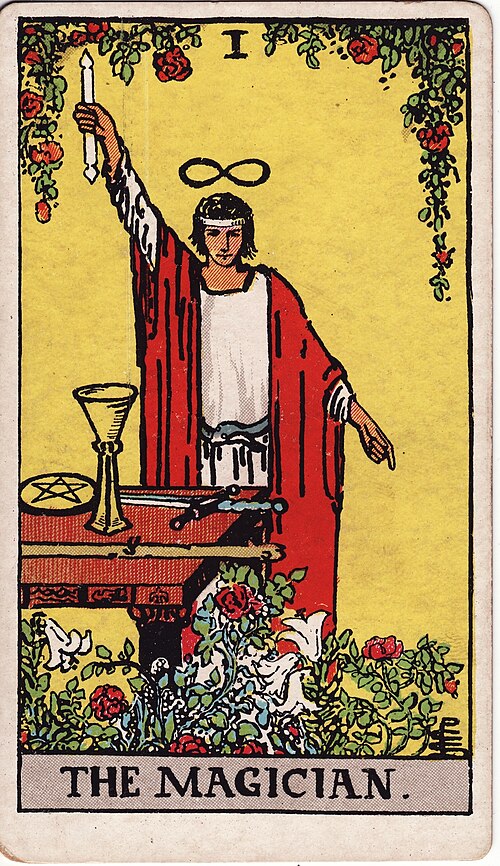
On the 1909 card an infinity sign floats over his head, and his belt is a snake biting its own tail. One hand holds a white wand aloft, the other points down. On the table lie a wand, a pentacle, a sword and a cup: the four suits. The white robe is read as purity; a red mantle, roses and lilies complete the scene.
Upright: everything to hand
In the tradition, The Magician upright stands for will, skill and the knack of turning an idea into work. Many readers take the gesture of his hands as a link between sky and earth: the plan above, the work below, and on the table all the tools it calls for. It is the card of the first practical step after an idea.
Reversed
Tradition describes The Magician reversed as power left lying idle, or as sleight of hand for its own sake. Many readers also see talk with no deeds behind it yet: the tools are on the table, and the work has not begun.
What the card is not
The Magician is no fairy-tale wizard and no forecast. He is an image of someone who knows how to use what is at hand. The infinity sign and the snake belt are details of the 1909 deck.
The Magician in the row
The Fool (0) comes before The Magician and The High Priestess (II) after him: a bold step, then skill, then silence. Tradition links the card with Mercury, the planet of words and quick wits. Tarot is a tradition and a language of images, not a science and not a forecast.
The calculation is astronomy; the interpretation is tradition.