The High Priestess (II): the tarot card
A scroll marked TORA, half hidden in her robes, and two pillars lettered J and B: The High Priestess seems to know more than she says. Card II of the tarot, she stands for intuition and silence.
Updated: November 11, 2026
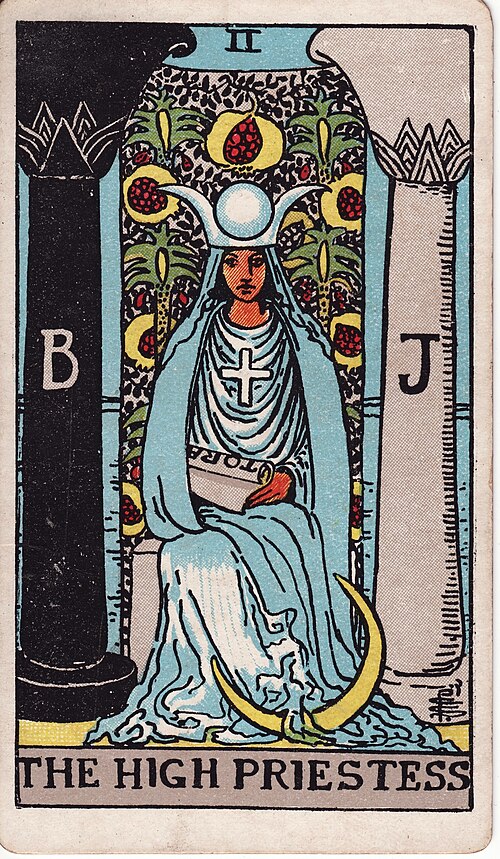
Once she was the Popess
The High Priestess bears the number II and follows The Magician. The card was first La Papesse, the Popess; Swiss decks put Juno in her place, and she became The High Priestess in decks made for reading. The Visconti-Sforza Popess has been identified as Sister Manfreda.
What the card shows
On the 1909 card she sits in plain blue robes, hands in her lap. She wears a horned diadem with a globe, a cross on her breast, and a crescent lies at her feet. Between a white and a black pillar, lettered J and B, hangs a veil of palms and pomegranates. The palms are read as male, the pomegranates as female.
Upright: knowledge ripening in silence
In the tradition, The High Priestess upright stands for intuition, silence and knowledge that ripens without hurry. Many readers see her as the inner voice: it speaks softly but to the point, and is easier to hear when all is quiet. Her knowledge is not loud: it comes as a hunch, a dream or a sudden clarity.
Reversed
Tradition describes the reversed card as distrust of one’s own sense of things: the inner voice is there, but it keeps being talked over. Many readers name a second reading as well, a secret kept for longer than makes sense.
What the card is not
The High Priestess is no keeper of other people’s secrets and no forecast. She is an image of attention turned inward. The letters on the pillars, the crescent and the scroll are details of the 1909 deck; older decks drew her differently.
The High Priestess in the row
The Magician (I) comes before her and The Empress (III) after her: from action the row moves to silence, and from silence to abundance. Tradition links the card with the Moon, the light of the night. Tarot is a tradition and a language of images, not a science and not a forecast.
The calculation is astronomy; the interpretation is tradition.