The Moon (XVIII): the tarot card
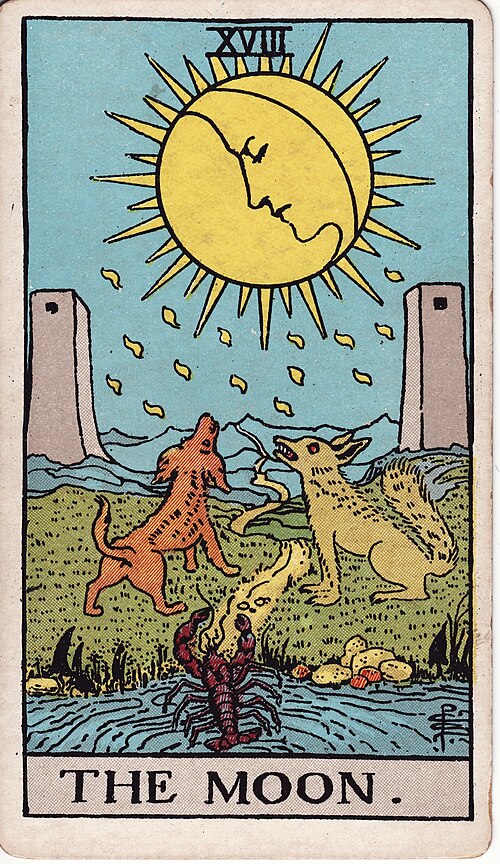
A dog and a wolf howl at the Moon while a crayfish crawls out of the water: night on this card is full of life. Card XVIII of the tarot, The Moon stands for uncertainty and imagination.
Updated: November 11, 2026
A night card with a long history
The Moon bears the number XVIII and follows The Star. Jean Dodal of Lyon made a classic Marseille-type deck between 1701 and 1715. Waite wrote that the card shows the life of the imagination apart from the life of the spirit.
Who howls at the Moon
On the 1909 card it is night, with two large pillars and the Moon in the sky. A wolf and a domestic dog howl at it, a crayfish climbs out of the water, and yod-shaped drops fall from above, fifteen of them. The dog and the wolf are often read as the tame and the wild in a person, the crayfish as what rises from the depths.
Upright: mist and fancy
In the tradition, The Moon upright stands for uncertainty, dreams and imagination. Many readers see a time when not everything is visible, so instinct and images count for more. It is no reason to shy away from the dark, rather an invitation to look closely at one’s dreams.
Reversed
Tradition reads The Moon reversed two ways: as mist lifting while the picture clears, or as self-deception growing deeper. Many readers also name a muffled instinct that is not given a voice.
What the card is not
The Moon is no sign of deceit by others and no forecast. It is an image of the night view, in which imagination paints more brightly. Night here is a time of dreams and fancies. The fifteen drops and the crayfish are details of the 1909 deck.
The Moon in the row
The Star (XVII) comes before The Moon and The Sun (XIX) after: night lies between a quiet light and a bright day. Tradition assigns the card to Pisces, and the Moon itself has a page of its own among the planets. Tarot is a tradition and a language of images, not a science and not a forecast.
The calculation is astronomy; the interpretation is tradition.