The Star (XVII): the tarot card
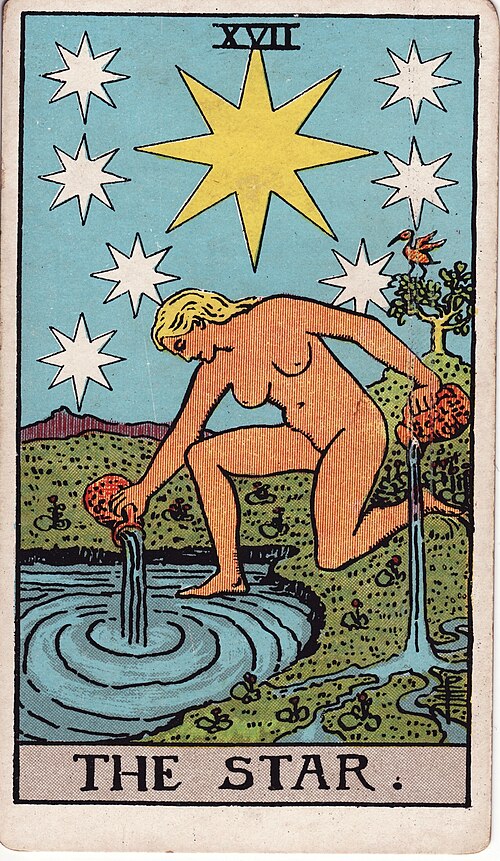
Night, water and a woman with two jugs, pouring generously into a pool and onto the earth. The Star is card XVII of the tarot, the card of hope and renewal, read as calm light after a storm.
Updated: November 11, 2026
When the cards began to be read
The Star bears the number XVII and follows The Tower. Some late fifteenth-century versions show a six-pointed star, sometimes with the three Magi standing below. Antoine Court de Gébelin published on tarot symbolism in 1781, in volume VIII of Le Monde primitif, and in 1783 Etteilla devised a method of his own.
What the card shows
On the 1909 card a naked woman kneels by the water, one foot in it and one on land. She holds a jug in each hand: one pours into the pool, the other onto the ground, where the water runs off in little streams. Above her shine one large star and seven smaller ones.
Upright: light after the storm
In the tradition, The Star upright stands for hope, renewal and calm. Many readers see it as rest after The Tower’s storm: no arguing, no proving, simply filling up again. The water flows freely from the jugs, as if there were enough for everyone.
Reversed
Tradition describes The Star reversed as hope grown dim, or as an empty jug, when there is nothing left to give. Many readers also name hope standing in for action: the dream is there, but no steps toward it.
What the card is not
The Star is no wish come true and no forecast. It is an image of a quiet light that brings strength back. The star shines quietly, yet it can be seen from afar. One large star and seven small ones are a detail of the 1909 deck.
The Star in the row
The Tower (XVI) comes before The Star and The Moon (XVIII) after: after the storm a clear sky, and after it a night full of riddles. Tradition assigns the card to Aquarius. Tarot is a tradition and a language of images, not a science and not a forecast.
The calculation is astronomy; the interpretation is tradition.