Death (XIII): the tarot card
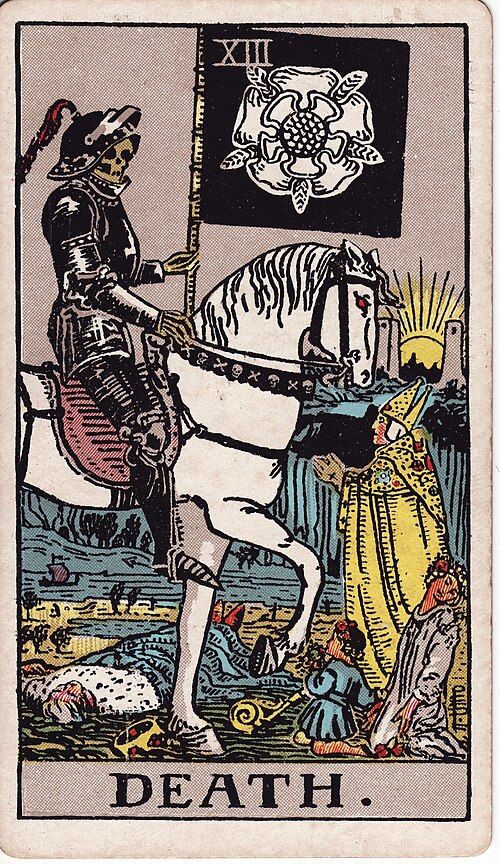
A skeleton rider with a white rose on his banner, and the sun rising on the horizon. Death is the thirteenth card of the tarot, and tradition reads it as the end of one chapter, not a perishing.
Updated: November 11, 2026
The card with no name
Death bears the number XIII and follows The Hanged Man. Marseille decks usually left it unlabelled, so it became “the card with no name”; Noblet’s deck of about 1650 names it. Some decks even retitle it “Rebirth”.
What the card shows
On the 1909 card a skeleton rides a horse and carries a black banner with a white rose. People of every rank stand before him, a bishop among them, and the horse steps over a fallen king. Far off, the sun rises between two towers. Other decks show Death on foot with a scythe; here it holds a banner.
Upright: a clean page
In the tradition, Death upright stands for an ending and a passage: something has finished, and room has opened for what comes next. Many readers compare it with autumn in a garden, where leaves fall to make way for spring shoots. The rising sun matters more here than the skeleton.
Reversed
Tradition describes Death reversed as an ending that meets resistance: the door has closed, yet the handle is still held. Many readers also see a slow change in it, one that keeps its own pace, without hurry and without drama.
What this card is not about
Death in tarot is not about physical death or health; it is an image of one stage giving way to another. Decisions about health, money or law are made with a doctor, a financial adviser or a lawyer; the tradition is a prompt for reflection, not medical, psychological, financial or legal advice.
Death in the row
The Hanged Man (XII) hangs before Death and Temperance (XIV) comes after it: a pause, then a change, then a new measure. Tradition assigns the card to Scorpio. Tarot is a tradition and a language of images, not a science and not a forecast.
The calculation is astronomy; the interpretation is tradition.