The Hanged Man (XII): the tarot card
A man hangs upside down, yet his face is calm, almost dreamy, and a halo glows round his head. The Hanged Man is card XII of the tarot, the card of pause, trust and a fresh view.
Updated: November 11, 2026
Where the pose comes from
The Hanged Man bears the number XII in most traditional decks and follows Justice. The image is a pittura infamante, a “shame painting” of the Italian cities. In tarot, though, the card stands for self-sacrifice more than for punishment, and that is how it is read today.
What the card shows
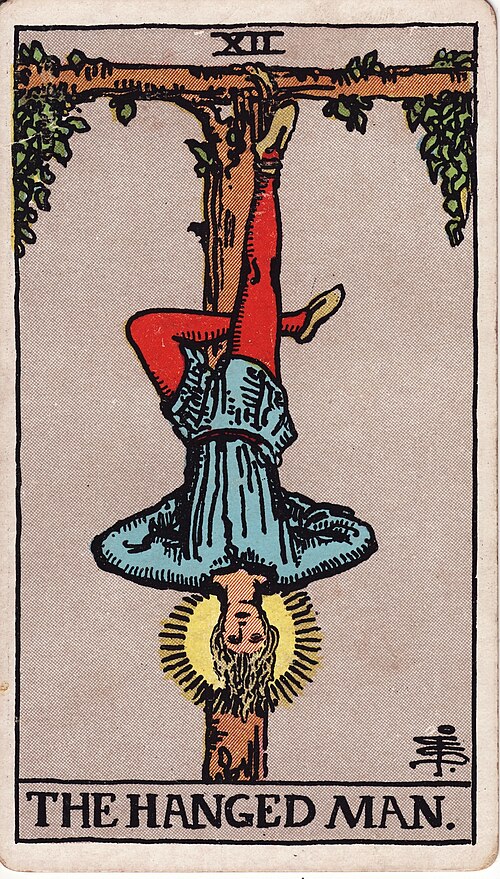
On the 1909 card a man hangs head down by one ankle from a T-shaped cross of living wood in leaf. His legs form a cross, and a halo surrounds his head. Waite wrote that his face shows entrancement, not suffering. The living wood is often read as a sign that this pause is alive, not dead.
Upright: a pause with a view
In the tradition, The Hanged Man upright stands for a pause, trust and a new view. Many readers see the moment when hurrying is pointless and it helps more to look at things from another side, quite literally upside down. Nothing gets done, yet a great deal comes into view. Sometimes the most useful move is to stop.
Reversed
Tradition describes The Hanged Man reversed as a pause that has lost its sense, or as resistance to stopping, when a person keeps running on regardless. Many readers also name a sacrifice nobody asked for, so that what was given goes unnoticed.
What the card is not
The Hanged Man is no punishment and no forecast. It is an image of a pause taken freely, after which the world looks different. Hanging upside down here simply means seeing the familiar anew. The living wood and the halo are details of the 1909 deck.
The Hanged Man in the row
Justice (XI) comes before The Hanged Man and Death (XIII) after: balance, then a pause, then a change. Tarot is a tradition and a language of images, not a science and not a forecast.
The calculation is astronomy; the interpretation is tradition.