The Empress (III): the tarot card
A crown of twelve stars, ripe wheat and water among the trees: everything on this card is growing. The Empress, card III of the tarot, stands for abundance and care, a creative power that knows how to nurture.
Updated: November 11, 2026
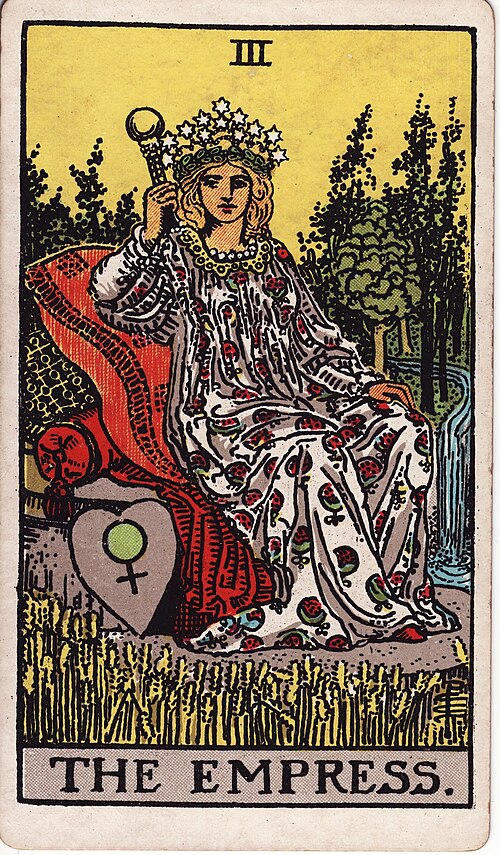
An empress with a shield
The Empress bears the number III and follows The High Priestess. In historical decks she sits on a throne with a shield or orb and a sceptre, and the shield bears the eagle of the Holy Roman Empire. Waite and other occultists added the starry crown, the emblem of Venus, the waterfall and the greenery.
What the card shows
On the 1909 card The Empress wears a crown of twelve stars and holds a sceptre. Beside her is a shield with the sign of Venus; wheat ripens before her, with trees and water behind. The wheat is often read as fertility and the fruit of work, the water as life flowing on its own.
Upright: a garden in bloom
In the tradition, The Empress upright stands for abundance, care and creative power. Many readers see in her the gift of nurturing: ideas, relationships, a home, a garden. Nothing here happens in a rush; everything gathers strength in its own time. Many call her the card of simple pleasures: warm bread, sunshine, a lovely garden.
Reversed
Tradition describes The Empress reversed as a neglected garden: the strength is there, but the attention is not. Many readers name the opposite side too, care in excess, so close and constant that there is no room left to grow.
What the card is not
The Empress is not only about motherhood, and she is no forecast. She is an image of care and growth in the widest sense. The starry crown and the sign of Venus belong to the 1909 deck; older shields bore an eagle.
The Empress in the row
The High Priestess (II) comes before The Empress and The Emperor (IV) after her: silence, then abundance, then order. Tradition links the card with Venus, the planet of love and beauty. Tarot is a tradition and a language of images, not a science and not a forecast.
The calculation is astronomy; the interpretation is tradition.