Justice (XI): the tarot card
Scales in the left hand, a sword in the right: Justice holds both sides of the question. Card XI of the 1909 deck, it stands for honesty and balance, answering for one’s own acts rather than punishment.
Updated: November 11, 2026
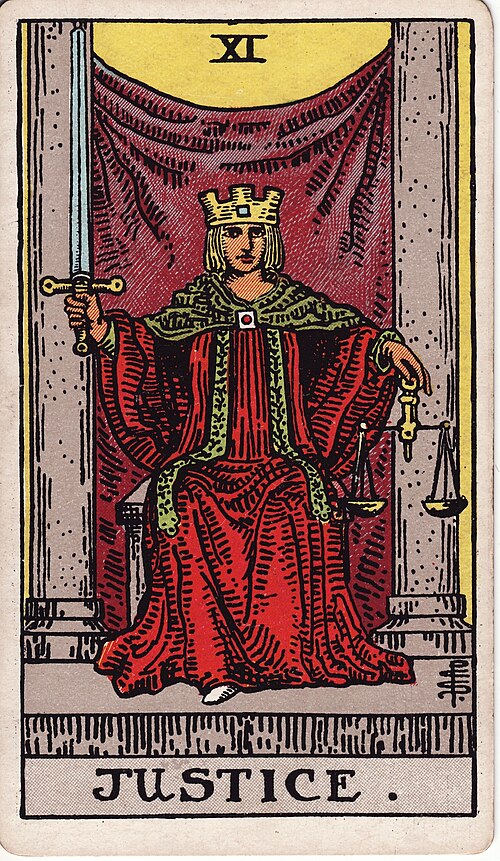
Eighth or eleventh
In the 1909 deck Justice bears the number XI and follows Wheel of Fortune. Traditionally it is the eighth card: in the Tarot de Marseille it comes right after The Chariot. The swap with Strength was first suggested in the Cipher Manuscripts, and the Golden Dawn paired the scales with Libra.
What the card shows
On the 1909 card Justice holds golden scales in her left hand and a sword in her right. The scales are often read as weighing every side, the sword as a clear decision that cuts away what is not needed. Together they speak of honesty with both softness and firmness in it.
Upright: an honest balance
In the tradition, Justice upright stands for honesty, balance and readiness to answer for one’s own acts. Many readers see in her a calm look at a situation from every side: no self-deception, no hunt for someone to blame, respect for the facts. The clarity here is soothing, not cold.
Reversed
Tradition describes Justice reversed as balance disturbed: the scales tilt, and someone takes on less than their share or more than they can carry. Many readers also name too harsh a verdict on oneself. The balance has not gone anywhere: it returns once the extra weight comes off a pan.
What the card is not
Justice in tarot is not about other people’s judgement, and it is no forecast. It is an image of inner honesty, the kind that makes breathing easier. It is XI only in decks that follow the 1909 pattern.
Justice in the row
Wheel of Fortune (X) comes before Justice and The Hanged Man (XII) after: a turn, then balance, then a pause. Tradition assigns the card to Libra. Tarot is a tradition and a language of images, not a science and not a forecast.
The calculation is astronomy; the interpretation is tradition.